





Founder ≠ CFO | Who Should Really Decide What as a Business Scales?
Every founder in India has, at some point, sat across a banker, investor, or auditor and answered a financial question with more confidence than accuracy. It’s not dishonesty, it’s instinct. The same instinct that got the business off the ground now quietly runs the finance function too. And for a while, it works. Until it doesn’t.
We’ve sat in enough board rooms and post-mortems to notice a pattern: businesses rarely collapse because the founder lacked vision. They stumble because the founder never stopped being the CFO.
The Founder’s Finance Trap
In the early days, wearing every hat is a badge of honour. The founder negotiates vendor terms, approves payroll, eyeballs the bank balance before big decisions, and treats the P&L as something they intuitively understand. This works when the business is small enough that intuition and reality rarely diverge.
But scale changes the math. A business doing ₹3 crore in revenue can survive on gut feel. A business doing ₹30 crore, raising a Series A, or expanding into a new state cannot. At that point, financial decisions stop being about “does this feel right” and start being about cash flow modelling, compliance exposure, investor reporting standards, and structuring choices that have five-year consequences.
We’ve watched founders discover, usually during due diligence, sometimes during a GST notice — that “I’ve been tracking it in my head” is not a financial control system.
Why the Founder Shouldn’t Be the CFO
This isn’t a competence argument. Most founders we work with are sharp, numerate, and genuinely good with money. The problem is structural, not personal.
A founder’s job is to make asymmetric bets, to say yes to the risky opportunity because the upside justifies it. A CFO’s job is closer to the opposite: to ask what happens if this bet goes wrong, and whether the business can survive that outcome. When one person holds both roles, one of those instincts quietly wins, usually the founder’s optimism.
This is where outsourced accounting services and compliance & regulatory functions earn their keep, not as a cost-saving measure, but as a structural checkpoint the founder can’t talk themselves out of.
We’ve seen the same story play out differently depending on whether that checkpoint existed:
- A founder who kept fundraising decisions entirely to himself missed a covenant breach buried in investor terms, a fractional finance advisor would have flagged it in a single read.
- A business that delayed hiring finance leadership “until it made sense financially” ended up restating three years of books before its Series B, delaying the round by five months.
- A founder-led compliance calendar missed an FDI filing deadline that a virtual CFO services partner would have tracked as routine, not urgent.
None of these founders were careless. They were simply doing two jobs that were never meant to be done by one person.
What Should Actually Sit With the CFO
As businesses scale in India, certain decisions need to move out of founder instinct and into structured ownership, regardless of whether that ownership comes from an in-house hire or fractional CFO services:
- Cash flow forecasting and working capital planning
- Investor and board reporting, where accuracy protects credibility
- Statutory compliance — GST, TDS, ROC, FEMA — where ignorance offers no legal cover
- Financial structuring for fundraising, M&A, or entity restructuring
- Internal controls that catch errors before an auditor does
The founder still owns the “why.” The CFO owns the “how, and at what risk.”
The Real Cost of Getting This Wrong
The businesses that get burned aren’t usually the ones with too little ambition. They’re the ones where financial oversight never caught up to operational ambition. A funding round stalls. A compliance lapse triggers penalties that were entirely avoidable. A board loses confidence in numbers that arrived late and changed twice.
For a growing mid-sized business or a funded startup, this is exactly where a dependable CFO service in India — whether full-time, fractional, or virtual, stops being optional. It’s not about replacing the founder’s judgment. It’s about giving that judgment something solid to stand on.
A Closing Thought, Not a Pitch
If you’re a founder reading this and recognising a little too much of your own week in it, that’s not a bad sign — it’s a common one. The businesses that scale well are usually the ones where the founder eventually hands the finance function to someone whose job is to worry about it full-time.
If that’s a conversation worth having, we’re happy to have it, reach out to FinsQ for a quiet, no-pressure discussion on virtual CFO services built for growing Indian businesses.
FAQs
1.Why do profitable businesses still run out of cash?
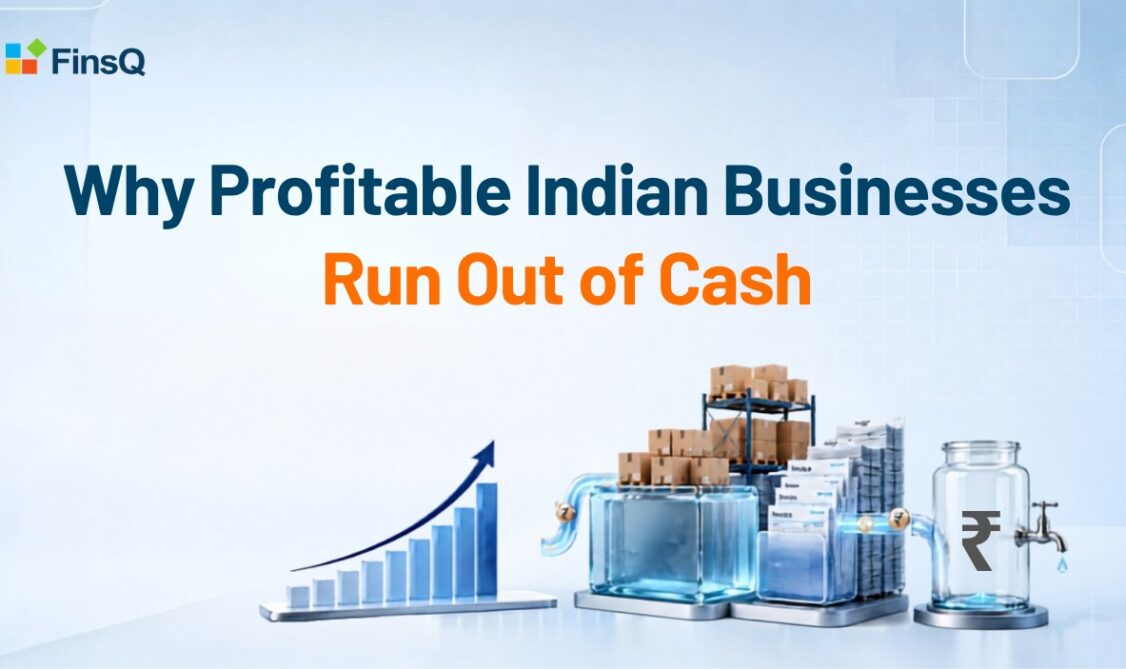
Profit is an accounting figure; cash is a timing problem. Collections lag, working capital gets tied up, and the gap goes unnoticed until it’s a crisis.
2. Are fractional CFO services only for startups?
No. Established mid-sized businesses use fractional CFO services too, especially during fundraising, restructuring, or expansion.
3. When should a business consider outsourced accounting services instead of an in-house team?
Typically when the cost and effort of hiring, training, and retaining an in-house finance team outweighs the benefit — common for businesses between early growth and mid-size, or those wanting access to senior expertise (compliance, MIS, reporting) without building an entire department from scratch.
4.What compliance risks do growing businesses in India most commonly miss?
GST mismatches, delayed or incorrect TDS filings, lapsed ROC/MCA filings, and FDI/FEMA compliance gaps for businesses with foreign investment. These rarely cause immediate damage, which is exactly why they’re missed — until an audit or notice makes them expensive.
5. How do I know if my business needs a CFO service in India right now?
If you can’t state your six-week cash position on the spot, or your board’s financial questions catch your team off guard, that’s the sign.